How to estimate a welcome email series' contribution to your online store's conversion rate: the formula, a worked example and how to turn conversion into revenue in pounds.
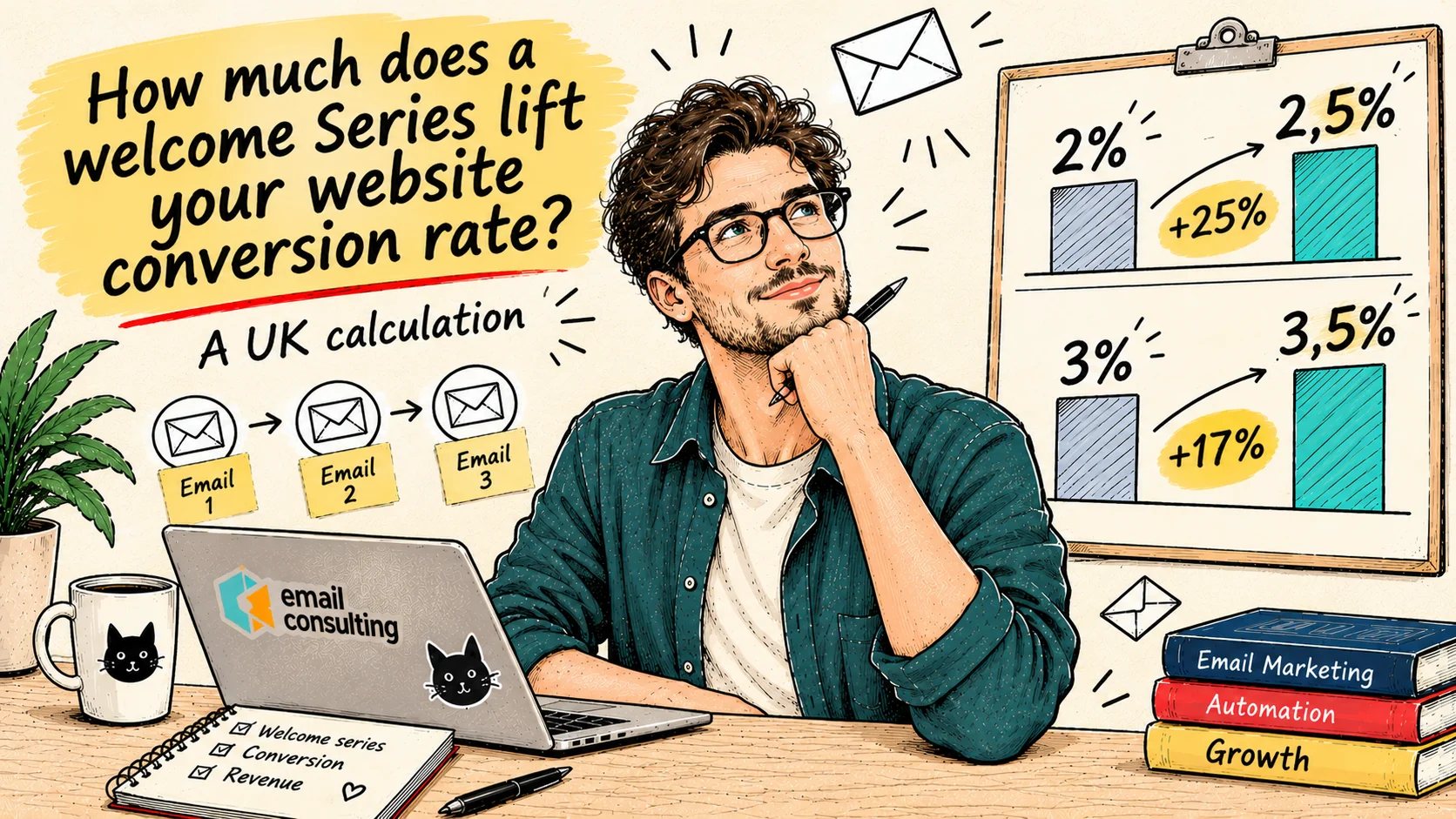
Short answer. +0.5 percentage points on your site's core conversion rate. Visitors arrive from search, then wander off to browse the rest of the internet while they make up their minds. If they leave their email in exchange for something worthwhile, you have a decent chance of bringing them back.
A welcome series is the first set of emails someone receives straight after signing up. They are still weighing up their options, have just handed over their email address and are expecting to hear from you, which makes it a natural moment to continue the conversation and nudge them towards a first purchase.
The idea is so obvious that it is often the one that gets forgotten: teams skip straight to more elaborate triggers that seem more important.
So let's put numbers on it: how to estimate a welcome series' impact on website conversion, how to calculate it on your own data, and how to turn the result into revenue.
For the example, we use illustrative figures: 5% of visitors sign up and 10% of subscribers buy from the series. That means the welcome series turns 0.5% of all website visitors into customers (the full calculation is below). What that means as a percentage lift depends on your current site conversion rate:
A welcome series picks up the people who visited, got interested but didn't buy first time: they left their email and came back from the inbox.
And that is only the welcome series. Once someone is on your list, they also receive your campaigns, abandoned basket emails and loyalty programme mailings.
That is why collecting emails on your site is a business decision, even if pop-ups personally drive you up the wall. Just make sure the form asks for consent properly: under UK GDPR and PECR, subscribers must actively opt in, with no pre-ticked boxes. And when the pop-ups get to you, look at the numbers. They are remarkably soothing.
Across the projects we work on, welcome emails account for anywhere from 10% to 70% of email marketing revenue, most often around 30%. Two things explain the range: your type of business and how long you have been trading.
Type of business. A welcome series takes the biggest share when:
Age of the business. The longer you trade, the smaller the welcome share. If you have shown ads to the same audience for three years, most of their addresses are already on your list and new sign-ups slow down. From then on, revenue grows through retention: regular campaigns and automated flows to your existing list.
First, break the journey from site visit to purchase into stages. An illustrative example for 1,000 visitors, where 5% sign up:
Traffic → purchase: 0.5%, or 5 out of 1,000.
The funnel shows exactly where people drop off. A low sign-up rate points to your form or your offer. A low open rate points to the first subject line or deliverability. Few clicks point to the email content.
A caveat on opens: Apple Mail Privacy Protection pre-loads emails for Apple Mail users, which counts as an open. An 80% open rate may therefore say more about Apple than about your subject line. Judge the series by clicks and orders.
Translate these conversion rates into money for a store with 50,000 monthly visitors and a £60 average order value, and you get an extra £15,000 a month.
All from emails that go out automatically, unlike promotional campaigns that someone has to plan, write and send every week.
Run the numbers for your own store:
The formula is simple:
Revenue = traffic × sign-up rate × subscriber conversion rate × AOV
Plug in your own figures from Google Analytics and your email platform. If you don't have a welcome series yet, treat the rates in the example as a working hypothesis and recalculate on real data after a month. Report revenue the same way your finance team does, either including or excluding VAT, so the forecast matches your accounts.
We have deliberately set the series conversion at 10%, because that is the low end. More often, 15–30% of the people who leave their details go on to buy, and raising that figure is the email marketer's job.
But that is a story for another article.
In the meantime, we hope this nudges you to start collecting emails on your site and turning those subscribers into customers.
If you'd like to estimate what a welcome series could do on your store's data, we can review your traffic, sign-up points and emails together and prepare a forecast. Book a free consultation.
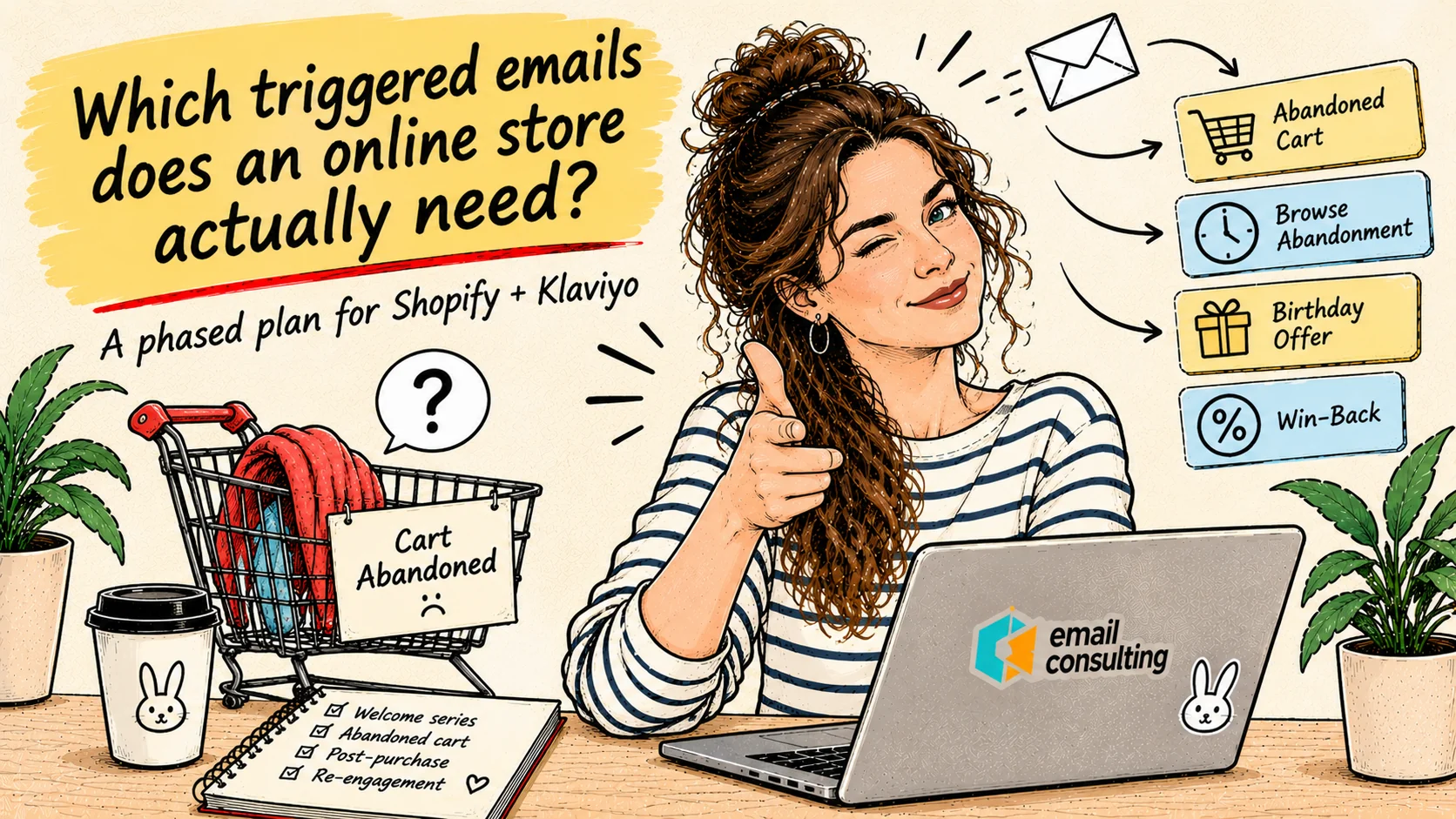
Which Klaviyo flows a Shopify store under 50,000 sessions should switch on, and in what order: welcome, abandoned checkout, repeat purchase, plus PECR consent rules.


